dinsdag 19 januari 2010

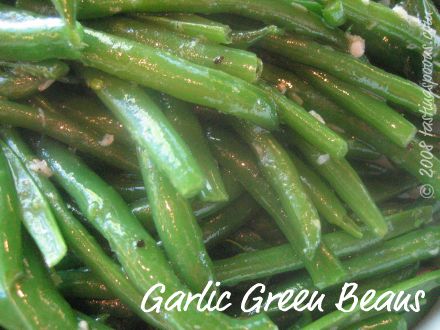
Green Beans with Garlic and Tea

http://tastingspoons.com/wp-content/uploads/2008/11/garlic-green-beans.jpg


Ingredients: 
1 lbs. fresh green beans, trimmed
2 cloves of garlic, minced
2 tbs. Keemun tea leaves, brewed in two cups of spring water


Directions:
Steam green beans in water.
While beans are steaming, sauté minced garlic in one teaspoon of canola oil until opaque.
Add brewed tea and simmer with garlic for a few minutes.
Remove beans from steamer and put in a large bowl.
Pour tea marinade over drained beans.
Garnish with toasted almond slices, as desired.
Serve immediately.

dinsdag 12 januari 2010

Cooking with tea

http://tasteofenglishtea.files.wordpress.com/2009/08/steaming-tea-leaves1.jpg
By Alexandra Zohn, Kiwi

Update your spice rack with tea! Since the discovery of the tea plant Camellia sinensis in China 5,000 years ago, tea has been a popular drink worldwide. But the Chinese didn’t just sip it–according to Diana Rosen, co-author of Cooking with Tea, they also used the leaves to prepare fish, duck and hard-boiled eggs. “Tea is like a non-chemical MSG,” Rosen says. “It’s hard to identify it as an ingredient in a dish, but it interacts with the flavors, adding a sparkle.”

Now, tea is making a comeback in the kitchens of the more experimental chefs as a creative way to add a little something extra to dishes. Just like spices, tea comes in flavors. White tea, from young leaves, is subtle with floral and citrus notes. Green tea can have a light, smoky flavor with grassy notes. Some Oolong teas have floral, fruity or spicy hints, while others have more roasted flavors. Black tea, the most commonly consumed tea worldwide, is astringent, and its flavor varies dramatically among regions. And like grapes used in wine, tea leaves come in varietals. Their colors, fragrances and tastes are products of climate, soil, altitude and rain–factors that are collectively known as terroir.

With all this variation, tea experts and aficionados recommend that you let your own palate guide you. “Each tea is individual and should be tasted first to find its predominant characteristic–is it sharp, soft, citrus, earthy or smoky?” Rosen says. “Then it can be matched with a recipe.” She suggests using intense teas when preparing intense-flavored dishes, and pairing delicate teas with delicate foods. “Sweet, grassy, green teas are wonderful in salads or with briny shrimp or egg dishes; black tea is great with meat or poultry, and it’s delicious in fruit compotes, where it cuts the sweetness,” she says. “Fruity teas are good for ice cream or egg sauces.” When cooking with tea, Rosen suggests experimenting with the flavors and using good quality tea. She cautions novice tea-cookers to take care not to cook the tea for too long and to go easy with the amounts used. And not to worry–cooking with tea is safe for the kids. With these delicious tea-infused recipes, soon the brew will have a permanent home in your spice rack. Heat up the kettle and start cooking!

Tea Tips: Here are the easiest ways to incorporate tea into your regular cooking routine.

• Place a tea bag in warm oil or butter for a few minutes to add flavor. Stir gently, cool and refrigerate. Flavored oils can be served in salad dressings or drizzled over soups. Tea-infused butter is a hit on pancakes and in pastry recipes.
• Use brewed tea instead of water when cooking rice or pasta.
• Infuse stocks for soups or sauces by placing a tea bag in them.
• Sprinkle tea on any food to season before cooking.

Perfect Pairings: Chas Kroll, executive director of the American Tea Masters Association, offers these suggestions when choosing tea to go with a particular food. Whether you’re sipping a brew or infusing the whole dish, these food-and-tea pairings are culinary matches made in heaven.

FOOD: Continental breakfast, rolls, toast, fruit, cereal
TEA: Assam, Ceylon, Darjeeling, Dooars, Indonesian, Kenya, Nilgiri, Terai, Travancore

FOOD: Eggs, meats, fried foods
TEA: Assam, African blends, Ceylon, Kenya, Lapsang Souchong, Tarry Souchong

FOOD: Light meals, tea sandwiches
TEA: Assam, Ceylon, Darjeeling, Green, Oolongs, Lapsang Souchong, Yunnan

FOOD: Spicy foods
TEA: Ceylon, Darjeeling, green teas, Keemun, Jasmine, Lapsang Souchong

FOOD: Strong cheeses
TEA: Earl Grey, green teas, Lapsang Souchong
woensdag 6 januari 2010

Better World Scones

http://ecx.images-amazon.com/images/I/51AKAhjcrmL._SL500_AA240_.jpg

Enjoying a cup of tea has always been a great comfort and joy to Linda O'Brien Hanley. Having a scone with her tea is an additional treat. When she decided to try to live her life by participating in as little exploitation as possible, she was determined not to give up this cherished experienced. She had to learn a new way to continue her love of baking and how to continue to enjoy the tea experience. This experience motivated her write this book and share what she learned with those whose share the same joys.


This book is for those who love tea and scones and also want to make every choice count toward a better world; comfort with hope. It is written to show how very small choices can make a difference. It does this by including recipes for scones made without dairy or eggs and using fair trade and organic ingredients. This books includes recipes for fifty scones, tips for making the perfect scones and tips for baking without dairy or eggs. A history of tea as well as tips on how to brew tea is also included. Resources for obtaining fair trade and organic ingredients are provided in the back.

woensdag 16 december 2009

Glazed chicken breasts in a honey lemon tea


In summer, add a radicchio salad and corn on the cob; in winter, serve with grilled radicchio and baked squash.

Ingredients: 
Water
2 tablespoons loose orange pekoe tea or 6 tea bags
2 tablespoons honey
1 lemon, juice and pared zest
2 boneless, skinless chicken breasts
Salt and pepper

Directions:
Pour 2 cups boiling water over loose orange pekoe tea or tea bags.
Stir in honey with pared zest and lemon juice.
Simmer 3 minutes, stirring just until honey melts.
Leave to infuse and cool.
Lay two boneless, skinless chicken breasts in a frying pan and strain tea mixture over.
Add salt and pepper to taste.
Cover, bring to boil and poach just below boiling on top of the stove, turning once, 20 to 30 minutes.
Remove chicken breasts when very tender if pierced with a two-pronged fork.
Turn heat to high and boil cooking liquid until reduced and starting to caramelize.
Replace chicken breasts and continue cooking, turning them so they become golden brown and coated with sauce, 2 to 3 minutes.
Serve warm or at room temperature, slicing to show the white meat inside.

donderdag 10 december 2009

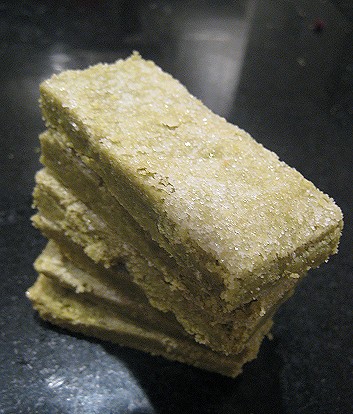
Macha Shortbread


These cookies are sooo unhealthy but oh so nice!  (ofcourse you can always leave out thesprinkled sugar on top)

Ingredients: 

2 sticks unsalted butter, softened
½ cup sugar, plus more for sprinkling
2 Tbsp macha (Japanese green tea powder)
1½ cups all-purpose flour
½ cup cornstarch

Directions: 

Preheat oven to 300 F.
In a bowl, whip together butter and sugar with electric mixer until soft and fluffy. 
Add macha (Japanese green tea) and mix until incorporated.
Add flour and cornstarch and mix well together. 
This should form a soft “dough.”
Place dough in 13x9-inch baking pan and spread out in an even layer. 
Sprinkle sugar on the surface as desired. 
Bake for about 40 minutes.
Let cool in pan and cut.

maandag 7 december 2009

Maghreb Mint Chocolate Chip Cookies

Maghreb Mint Chocolate Chip Tea Cookies 


“Tea is very versatile in the way it can be prepared. For this recipe I infused butter with tea to give the cookies their very special and exotic flavors. As you bite into these soft and chewy cookies, the first flavors are the very aromatic licorice root, cardamom and clove which are then followed by the sweetness of mint which lingers in your mouth. The best part about this recipe is that everyone has their favorite chocolate chip recipe! Simply infuse the butter and add to your own recipe.”

—Susana Mojica

Ingredients:
3 sticks of butter
1 ounce (28 grams) of Rishi Tea Maghreb Mint green tea/Minty Green chai, dry
2 cups of unbleached flour
½ teaspoon of salt
1 teaspoon baking soda
2 large organic vegetarian cage-free eggs
1 cup of raw sugar
1 teaspoon vanilla
1 cup of organic brown sugar
1 bag of semisweet chocolate chips
½ cup of chopped walnuts


Directions for Magreb Mint infused butter: 
Over a very low flame, melt three sticks of butter in a pan.
Add one ounce of Maghreb Mint once butter is completely melted.
Simmer over low flame for about 30 minutes, monitoring closely so that the butter does not burn.
Strain tea from butter using infuser basket, cheese cloth, or strainer. 
You should have one cup of melted Maghreb Mint butter remaining for this recipe.
Allow butter to cool completely before using.

Directions for making cookies: 
Preheat oven to 375 degrees.
In one bowl blend flour, salt and baking soda.
In a larger bowl, pour in the cup of Maghreb Mint butter; add eggs, beating well between each egg, then the vanilla, and beat mixture at a low speed until creamy.
Add flour, chocolate chips, and walnuts to mixture and stir until all ingredients are evenly distributed.
Drop batter by the spoonful onto ungreased cookie sheets and bake for 8-11 minutes or until golden brown.  Do not over bake.
Remove from oven and let cool before enjoying.

Makes approximately 30 cookies.

donderdag 3 december 2009

Tea with a twist

http://vintagetea.com/images/Tea_with_a_Twist_1.jpg You should all know by now that I am an absolute tea-freak.  One of the things I absolutely love when I am in the UK is hunt for special tea books.  One I recently bought is the book by Lisa Richardson: Tea with a twist.

Lisa Boalt Richardson


Tea lovers craving new and novel ideas for their next tea party will gladly put the kettle on...and the doilies away. There’s nothing old–fashioned here! Specialty tea expert and author Lisa Boalt Richardson inspires readers to set their tables for fun and serve up any of her eight contemporary tea parties. Stunning photographs by one of Atlanta’s leading photographers Lauren Rubinstein grace each page, enticing readers to indulge their guests and serve them fine tea in a fun style!

The parties are simple to put together. Each tea includes easy–to–follow instructions and budget–friendly tips for brewing specialty teas, preparing delicious recipes, and decorating tables. Whether the cook chooses to pour tall glasses of the unusual bubble tea for fun–loving friends or hot, exotic masala chai tea for those seeking an adventure, it’s certain that tea time has a new twist!

dinsdag 1 december 2009

Berry Good Chai Pie

http://x7d.xanga.com/490f5b12d5632247926070/z196581597.bmp


To continue on the Chai theme ;-)  Try this yummy dessert with Chai concentrate and ripe, juicy strawberries. The fruit for the pie should be fresh, but you can use frozen berries for the glaze. The spiciness of the Chai complements the fresh fruit very nicely. 

Ingredients:  
1 pre-baked pie crust (plain, whole wheat, or graham cracker), cooled to room temperature
1 quart fresh whole strawberries
1/2 cup fresh or frozen strawberries, crushed
1/2 cup Chai liquid concentrate, any flavour, any brand
2 Tablespoons  sweetener
2 teaspoons cornstarch
 

Directions: 
Cut the whole strawberries into thin slices and arrange the slices in the pie crust. 
Combine the crushed strawberries and Chai concentrate in a small saucepan. 
Bring the mixture to a boil, then reduce heat to medium and cook for two or three minutes, stirring constantly. Remove from heat. 
In a small mixing bowl combine the sweetener and cornstarch and mix well. 
Strain the Chai mixture through a fine sieve into the bowl and blend thoroughly (a wire whisk works very well). Return this blend to the saucepan and cook over medium heat until it is clear and thickened, stirring constantly to prevent burning and sticking. 
Remove from heat and cool for five or ten minutes. 
Use a pastry brush to lightly coat the edges of the crust with glaze, then spoon the rest of the glaze evenly over the strawberries. 
Serve immediately, or chill briefly. 
This pie does not keep well, so serve it within a few hours of preparation. (The crust can be prepared in advance.)

zaterdag 28 november 2009

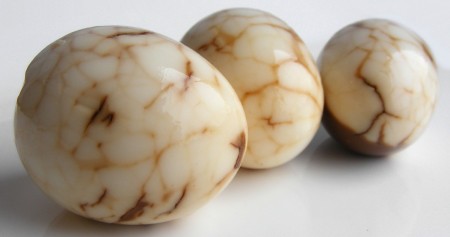
Tea- Marbled Eggs

http://farm4.static.flickr.com/3392/3413090326_2ce4ab5751.jpg


Ingredients: 
3 cups water
8 small eggs (or 24 quail eggs)
4 tea bags of black tea or 2 tbs. of loose-leaf black tea, e.g. Keemun
1 tbs. salt 


Directions:  
Cover the eggs in a pot with cold water and bring to a boil, simmer for 10-12 minutes.
Remove eggs with slotted spoon, reserving the water.
Place eggs in cold water to cool and, when they're comfortable enough to handle, gently tap the eggs all over with the back of a teaspoon to make cracks.
Add tea leaves to the reserved water and then place the eggs back in gently and add the salt.
Simmer covered for an hour.
Take the pot off the stove and leave the eggs in tea water to soak for 30 more minutes.
Remove eggs and allow them to cool before removing the shells.
The eggs will then have a cobweb of brown lines not unlike those found on fine marble.
Halve them and sprinkle with paprika and minced parsley for added color.
If using smaller eggs, no garnish is necessary. 

vrijdag 27 november 2009

More Chai :-)

http://www.culinaryteas.com/Store/Masala_Chai.jpg

The Chai recipe I posted yesterday really started something :-)

So yes, please send me YOUR favorite Chai recipe too.

Debby Lovell has a wonderfyul recipe for Chai Meringues.

Ingredients: 
3 egg whites
1 c. granulated sugar
1/2 teaspoon cardamom
1/4 teaspoon cinnamon
1/4 teaspoon ground cloves

Directions: 

Beat the egg whites with an electric mixer at low until they get foamy, then at high speed until they form stiff peaks.
You should be able to turn the bowl sideways without the egg whites moving.
Your bowl and beaters must be grease-free for this to work properly!
Gradually add sugar a little at a time while beating at high speed.
When all the sugar has been beaten in, the egg whites will look shiny.
Add the spices and beat in as briefly as possible.
Drop the mixture into small mounds on baking sheets that have been covered with foil or parchment paper.
Bake at 250 degree Farenheit for 90 minutes.
Turn off the oven and leave the meringues to sit.
Don't open the door!
Let them sit overnight (preferable) or at least until the oven cools.
Remove them from the foil and store in an airtight container.

For those Chai lovers amongst you who are still looking for the perfect Christmas present, have a look at this little gem:
http://www.rdranch.net/catalog/images/chai.bmp

Diana Rosen has done an excellent job of blending the romantic culture with the traditions of making and serving tea that transcends all classes and castes of the India subcontinent. After reading 'Chai' I ordered six more copies as gifts for my close friends. Everyone who enjoys a cup of tea, and what it can bring, will love this tasty and instructive book.

donderdag 26 november 2009

Chai

http://www.beyondthebean.com/assets/Chai_Cups.jpg

As winter draws near I am longing for a hot cup of Chai tea.

In many parts of the world, the word for tea is pronounced as "chai." 

The name Chai has also more popularly become known as a spiced tea-based beverage. You can find Chai offered hot or iced in many coffee houses, tea houses, and restaurants. And there are several brands of ready-made Chai as well as mixes and concentrates. But nothing tastes as good as making your own. It takes more time than using a mix, but the results are very much worth it. Soy milk tends to separate when boiled so I prefer rice milk, either in plain or vanilla flavour. Use the freshest spices -- you will definitely notice the difference in flavour and aroma. Adjust the quantity of each to suit your own taste. 

Ingredients: 
3 cups rice milk, plain or vanilla flavoured
3 cups water
sweetener of your choice
2 Tablespoons black tea leaves (try Assam or a breakfast blend)
1 two-inch or longer cinnamon stick
8 whole black peppercorns
2 whole cloves
4 cardamom seeds
1/4 teaspoon whole cumin seeds
2 whole allspice
1/8 teaspoon ground nutmeg


Directions: 
Mix the milk, water, sweetener, and tea leaves in a saucepan and bring to a boil.
As soon as the mixture boils, turn off the heat and stir in all the spices. 
Cover the pan and allow the tea and spices to steep for fifteen minutes. 
Remove the cover, stir, and heat again to a boil. 
Again as soon as it reaches the boil, remove from the heat. 
Pour the mixture through a fine strainer or sieve into a teapot or directly into individual teacups or mugs to serve. 
Can be stored in an airtight container for up to two days, and served chilled or reheated. 

dinsdag 24 november 2009

Banana Coconut tea loaf

https://blogger.googleusercontent.com/img/b/R29vZ2xl/AVvXsEgwdGooayapHxC9KBCrJvyGfkjnJEOSyG_orHI-ZG9aJJJ0EeKoSjmyCGE2vtqQE6xamFbajtlVuQ99NsmwlhTQoykl7uUZyOFHkGS-PBCu_ra_ww5Uocvsgh5evBRPhltHkocpa-XX7i4/s400/banana+bread+tall+slices.JPG


For afternoon tea, slice the loaf and serve with almond butter and unsweetened fruit preserves. 
Nice lightly toasted, too. 
Accompany with a second-flush Darjeeling or a tippy full-leaf Assam.

Ingredients: 
3 cups unbleached or whole-wheat pastry flour, or a combination of the two
1 cup unsweetened shredded coconut
4 teaspoons baking powder
1 teaspoon baking soda
2 Tablespoons sunflower or other light oil
2 Tablespoons maple syrup or alternative liquid/syrupy sweetener
4 very ripe bananas, mashed well


Directions:   
Preheat oven to 350 deg F. Lightly oil and flour a loaf pan. Combine the flour, coconut, powder, and soda in a large mixing bowl. Add remaining ingredients, mixing together well with a wooden spoon or your hands, as batter will be thick. Spread evenly into the loaf pan, smoothing the top. Bake 40 to 45 minutes or until a toothpick stuck into the middle comes out clean. Cool for at least twenty minutes before slicing and serving. You can leave the loaf in the pan or remove it to a serving dish or storage container.

donderdag 19 november 2009

Darjeeling: Sultan's Tea

http://potlucktea.com/images/PotLuck/tea_packet2.jpg

The main problem with Dareeling tea is quantity: there will never be enough to satisfy demand. The region is small and produces much less per acre than Assam, for instance. It is colder and higher, growth is slow, and the crop devilishly difficult to harvest.

Even in a good year production amounts to only twenty two million pounds or so, less than one percent of all the tea India produces. Yet this is unquestionably India's best-known tea and the passionate aficionados of the Cult of Darjeeling are among the worlds most discriminating tea lovers.
Like the great Burgundy wines of France, Darjeeling teas often disappoint. In exceptional years, however, when a flavor unique to Darjeeling which cannot be replicated anywhere else in the world is pronounced, these teas are simply spectacular. In these favored years it takes no connoisseur to explain why the name Darjeeling deserves its fame.

http://img6.travelblog.org/Photos/50150/284186/f/2408500-Darjeeling-tea-plantation-1.jpg

Kanchenjunga, one of the world's tallest peaks, rises east of Darjeeling and is among its chief attractions. Mountain slopes of less than forty-five degrees are considered almost level by Darjeeling standards: planting on slopes up to sixty or seventy degrees is the rule, not the exception. These steep slopes provide natural drainage for the generous rainfall the mountainsides receive from seasonal monsoon winds. Tea will not grow at elevations much above six thousand feet. In these Himalayan foothills it is planted from approximately eighteen hundred to sixty-three hundred feet, which makes much Darjeeling pretty nearly mile-high grown tea. Each garden varies considerably in altitude and many a property could follow the example of Namring, which sells a Minting Upper to distinguish its higher-grown tea from the lower-grown Namring, tout court.
The higher it is grown, the thinner a tea's body and the more concentrated its flavor as a rule. Yet altitude is only one factor determining the quality of Darjeeling. The intermittent cloud and sunshine playing over the slopes make their contribution, as do exposure, that is, the direction a slope faces, and a host of other variables like the soil chemistry, temperature and rainfall unique to the area. Another-and more surprising-factor affecting tea taste is the wind.

An additional explanation for Darjeeling's uniqueness is the type of tea plants grown. Most are of the China or China-hybrid type, which are found almost nowhere outside China and Japan except in Darjeeling and the Caucasus. These plants are more resistant to cold than India's native hush, the Assam jat or type, but their yield is much lower and the leaf smaller. On China hush this small leathery leaf is a dark glossy green, often covered with silvery down.
Since the tender young shoots must be harvested as soon as they are ready, each bush on an estate must he hand-plucked every four to eight days throughout the growing season. A typical plant yields only about one hundred grams per year, that is, maybe four ounces, of made tea. This is less than a third the yield of Assam plants growing in the plains. Each kilogram of Darjeeling consists of over twenty thousand individual shoots; about half as many are required for the same weight of tea produced from the large-leaf Assam jat. Such figures serve to illustrate the extent of human effort that Darjeeling tea requires.

All Darjeeling is processed by the traditional Orthodox method of black tea manufacture, but today's teas are made in a different style from previous ones. As Prohibition destroyed the U.S. vine industry, World War II, and Indian independence soon after, unsettled Darjeeling's traditional ways. The style of teas produced there since the 1950s is widely attributed to the inspiration of German tea man Bernd Wulf. Today, individual Darjeeling teas are often as recognizably unique as human personalities. The different batches of fresh leaf brought to a factory require intricate variations in processing to realize their full potential. Each day's batch is plucked from a different section of the garden and is processed and packed as a separate "invoice." In less than twenty-four hours this batch of green leaf has been transformed into an invoice of "made tea" in chests, usually five to ten, which are then sold together as a single lot at auction. For tea professionals and connoisseurs, each invoice produced in the spring and summer has a separate and memorable personality. In response to growing appreciation, more and more retail shops and catalogs identify teas from Darjeeling for these discriminating consumers by garden name, flush, and even specific invoice number.

The character and quality of Darjeeling tea varies dramatically over the course of each year. Foliage functions as the skin of a plant. The texture and flavor of the tea leaf change continuously with the climate and season, even in the same sections in each plantation. In fact, these alter not just with the seasons but also week to week, day to day, and morning to evening, depending on the type of bush, the wind, humidity, sun and other factors already mentioned.

After a period of dormancy in winter months, Darjeeling's tea plants wake up in early March and begin putting forth the first new growth or "flush" of the year, delicate slender shoots with a glazed grey-green appearance. First Flush season often lasts into early May, though unseasonal rains sometimes render the whole crop a disaster. This crop's unique quality results from the leaf growing in intense sunshine but in the cold crystalline Himalayan air of early spring. These growing conditions make First Flush Darjeeling a puckery young tea, almost as light as any green but, unlike greens, flamboyantly aromatic. Infused leaf shows a pronounced lime greenish brightness. These are the Spring Teas, as they are also known, always amazingly fresh and flowery tasting. Amazingly astringent too, and easily oversteeped. I like them best after three minutes, or three and a half, seldom more. So delicate is First Flush Darjeeling that it especially well repays using water about thirty degrees below boiling, as in preparing green tea.

Incredible prices are paid at the Calcutta auctions each spring for the most stylish or prestigious invoices (lots of usually two to five chests) of Darjeeling's Spring teas. Throughout the '90s each year's priciest tea at auction regularly brought over US$500 per kilo. Except for certain rarities, Chinese and Taiwanese mostly, First Flush Darjeeling is the world's costliest tea. It is much sought after by wealthy Indian buyers, who must compete with brokers acting for German and Japanese importers and the occasional sultan as well.

woensdag 18 november 2009

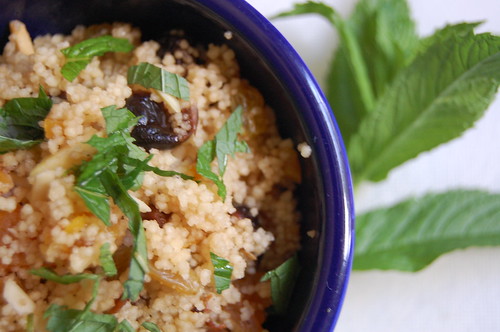
Fruited couscous

http://farm4.static.flickr.com/3329/3670439576_46fb718dd7.jpg

If you've never tried couscous,  this might be just the dish to start with. 
Serve hot as a breakfast cereal or chilled for dessert. 
For breakfast, top with plain or vanilla soy milk or cultured soy "yoghurt." 
The tea I prefer for this dish is called Citrus Blend.   It is a black tea flavoured with the citrusy oils of bergamot, orange, and lemon, and it makes a delightful cuppa on its own. You can also use a regular Earl Grey, or even a plain black tea. Whichever you choose, steep the tea to normal strength rather than extra-strong so it doesn't overpower the other flavours.


Ingredients:  
1 cup regular-strength steeped tea
1/2 cup water
1/2 cup fresh or not-from-concentrate orange juice
1/2 cup raisins
1 ripe banana, sliced thinly
1/4 cup maple syrup or alternative syrupy/liquid sweetener
1/2 teaspoon ground cinnamon
1 cup couscous, preferably whole wheat


Directions:  
Place all ingredients in a saucepan and stir. Bring to a boil over medium-high heat, stirring occasionally. Reduce heat, cover, and simmer for about 5 minutes. Remove from heat and let rest in the pan for about ten minutes. Fluff with a fork and serve hot, or transfer to an airtight container and chill several hours or overnight.


Variation:
> Replace the cinnamon with 1 teaspoon vanilla.

dinsdag 17 november 2009

Applesauce tea loaf

http://www.canadianliving.com/blogs/seasons/files/2009/10/dsc04286-450x337.jpg

What better for holiday tea times -- or any time -- than a fruity tea bread? Please note that if you use cranberries, you should look for the unsweetened kind. The ones you find in the supermarket are generally presweetened, so if you use them be sure to reduce the amount of added sweetener by up to a Tablespoon. A malty Assam or a black blended tea would complement this teatime treat.

Ingredients:
2 cups unsweetened applesauce
1/2 cup sunflower or other light oil
1 cup Sucanat® or alternate granulated sweetener of your choice
1 teaspoon vanilla
2 cups unbleached or whole wheat pastry flour
2 teaspoons baking soda
1 teaspoon ground cinnamon
1/2 teaspoon ground nutmeg
1/2 cup seedless raisins, dried currants, or dried cranberries
Additional applesauce, optional

Directions:
Preheat oven to 350 deg F. Prepare a loaf pan by lightly oiling and flouring. In large mixing bowl, stir together the applesauce, oil, sweetener, and vanilla. In a separate bowl or on a sheet of wax paper mix together the dry ingredients: flour, soda, and spices. Blend these into the wet ingredients with a wooden spoon, beating vigourously until smooth. Mix in the dried fruit, blending well to distribute evenly. Pour the batter into the loaf pan, smoothing the top with the spoon. Bake for 45 to 50 minutes, or until a toothpick inserted in the middle comes out clean. Leave the loaf in the pan to cool to room temperature before slicing. Serve topped with a spoonful or two of applesauce, if desired.

Letter to Santa

I came across this old letter onthe internet today. Since the Holiday Season is almost upon us, I just needed to share :-)

Dear Santa,

This year, my holiday wishes have changed.

I've decided not to ask for a puppy again (as this request has gone unrequited for our past two correspondences), but instead have found something even more desirable: tea. In the past year, I have discovered many interesting facts and fascinating stories about this delicious beverage, and am now officially hooked! In this letter, I hope to prove to you that tea is the perfect gift for me and everyone on your list this holiday season.

As I'm sure you know, Santa, the gift of tea is not a new idea. In the past, tea gifts have changed history, incited trends and made legends. According to one ancient Chinese legend, Kuan Yin, the Goddess of Mercy, presented tea as a gift to a devout farmer who diligently maintained her old, dilapidated temple.

Inside the temple was Kuan Yin's elegant iron statue to whom followers prayed for enlightenment. One day, however, the iron statue appeared to come alive. Shocked, the janitorial farmer fell to his knees and the goddess whispered," The key for your future is just outside this temple. Nourish it with tenderness; it will support you and yours for generations to come." Unable to contain his curiosity, he went outside and found a withered, straggly bush.

After much care, the bush grew rich and full, with thick green leaves. Experimenting, the farmer dried the leaves in a stone wok. They soon turned a smooth charcoal black, just like the statue of Kuan Yin. The nectar produced from leaves fired in this way was ambrosial and fragrant, like the finest blossoms. It was more delicious than any other drink that ever touched his lips. Thus, the magical Ti Kuan Yin - "the tea of Kuan Yin" - came into being.

Yet another excellent tea gift was given in 1660, when Charles II (referred to as the "Merry Christmas Monarch") brought the gift of tea to England. When he first married Portuguese Princess Catherine, they were forced to live in exile in Denmark (thanks to Oliver Cromwell). At that time in Denmark, tea was already enjoying widespread popularity and both Charles and Catherine were huge fans. When Cromwell misplaced his head, the couple was able to return to England. They brought a chest of tea with them, which was met with thirsty enthusiasm by the British court. This gift provoked the craze for tea in Great Britain (in which the English are still fully embroiled).

And let's not forget, Mr. Claus, about the most famous example of a monumental tea gift: the recipe for Earl Grey. Legend says that in 1830, an Englishman named Charles Earl Grey traveled on a diplomatic mission to China. During this time, he risked his life to save the drowning child of a Chinese noble. In return for his act of kindness, the mandarin presented him with the recipe for making this distinctive tea.

However, a few corrections are in order to present an accurate historical record (and to keep me off of your "naughty" list). Firstly, the Chinese have never been black tea drinkers, and were unlikely to have a recipe for Earl Grey to bestow on visitors. Secondly, Charles Earl Grey never set foot in China. Otherwise, the story is completely true.

As you can see, Santa, tea gifts have had a significant influence. So please keep this in mind when filling my stockings and bedecking my tree. I'm not saying, by any means, that I need a history-altering event; just a delicious drink that will both relax me through the holiday stress and warm me against winter's cold.

Don't worry- I'll be sure to leave out a few tea biscuits for you and Rudolph, just to remind you.

Still believing,
Chris
Age 25
December, 2004

woensdag 28 oktober 2009

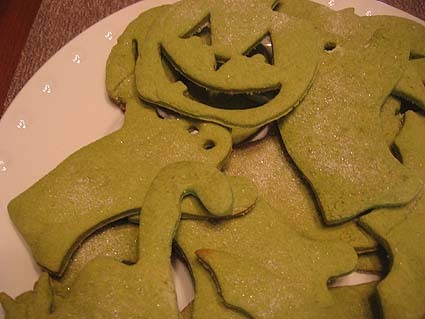
Green Tea Halloween Sugar Cookies

title

If you liked the Green tea cake, I've got another spooky recipe for you.  You can bake round cookies, but if you use special halloween cookie cutters you really get some great shapes.

Ingredients:
1/2 cup (1 stick) unsalted butter
3/4 cup packed light brown sugar
1 tsp vanilla extract
1 large egg
2 cups all-purpose flour
2 tsp matcha
1/2 tsp non-aluminum baking powder
1/4 tsp sea salt
2-3 tbsp milk
3 tbsp granulated sugar

Directions: 
In large bowl with electric mixer at medium speed, beat butter, sugar and vanilla until light and fluffy. Beat in egg until well blended.
In a separate bowl combine flour, matcha, baking powder and salt; then, with mixer at low speed, beat into butter mixture to blend well. If mixture is a little dry, add 2-3 tablespoons milk until it comes together. Form dough into two balls. Wrap in plastic and refrigerate until firm, at least an hour or overnight.
Preheat oven to 350 degrees. Roll dough out on a lightly floured surface and cut into shapes using cookie cutters. Sprinkle unbaked cookies with a little granulated sugar.
Place about 1–1/2 inches apart on ungreased, parchment paper-lined baking sheet. Bake 10–12 minutes. Cool on wire rack and store in an airtight container.


dinsdag 27 oktober 2009

Green Tea Cake

http://a1.vox.com/6a00d4141eebb4685e00d4142a54e96a47-500pi

It's almost Halloween so what better than to serve a yummy GREEN cake :-)

Ingredients:
4 eggs
1 3/4 c flour
1 1/2 c sugar
3/4 c butter
2 T green tea powder (Macha gives the best results - do NOT buy Sencha or you will not end up with a green cake)
1 T chocolate chips (optional)

Directions:
Put butter in a bowl and stir until soft.
Add sugar, mix well.
Add eggs.
Sift flour and green tea powder together, add to mix, add chips if you want.
Place baking wax paper into medium loaf pan (I grease 3-4 mini loaf pans and make individual cakes instead).
Bake at 360 degrees (182 celsius) for 35 minutes.

vrijdag 23 oktober 2009

oatmeal chocolate chip honeybush cookies

http://www.twolooseteeth.com/images/2008/cookies-thumb.jpg

I don't know why but come October and I seem to yearn for oatmeal cookies. These cookies are soft and full of oats and chocolate chips with the presence of honeybush tea to bring the other flavors together. I always tend to keep a few but since they are wonderful warm while the chocolate chips are still melty we never leave them to eat cooled as a snack.

Ingredients:
1 cup walnut butter
1 cup dark brown sugar
1 tsp vanilla
1 egg
1/4 cup double strength honeybush tea, completely cooled
2 and 1/2 cup old fashioned oats
3/4 cup unbleached flour
1 tsp crushed honeybush tea leaves
3/4 tsp baking powder
1/3 tsp baking soda
1/4 tsp salt
1 and 1/4 cup chocolate chips
Directions:
Preheat over to 375 degrees.

In a bowl combine the oats, flour, tea leaves, baking powder, baking soda, and salt. Set aside.

In a mixing bowl beat walnut butter, brown sugar, and vanilla together.
Beat in the egg and the tea. Make sure the mixture is well beaten.

Add chocolate chips and part of the dry ingredients. Begin mixing again, add the rest of the dry ingredients a little bit at a time, just until combined.

Drop small rounded spoonfuls onto a cookie sheet lined with parchment paper. Press the dough to about 1/2 inch.

Bake at 375 for about 10 to 12 minutes.
Do not over bake these cookies.

When done cool on wire rack, and enjoy.

Store in an airtight contairer, but they are best the day they are made.

woensdag 21 oktober 2009

Earl Grey tea

http://www.ibiblio.org/fiddlers/earlgrey.jpg
Any Star Trek fan knows that Captain Picard drinks Earl Grey tea (hot!). Well, lots of other people drink Earl Grey too. It's one of the most popular and best known kinds of tea in the Western world.

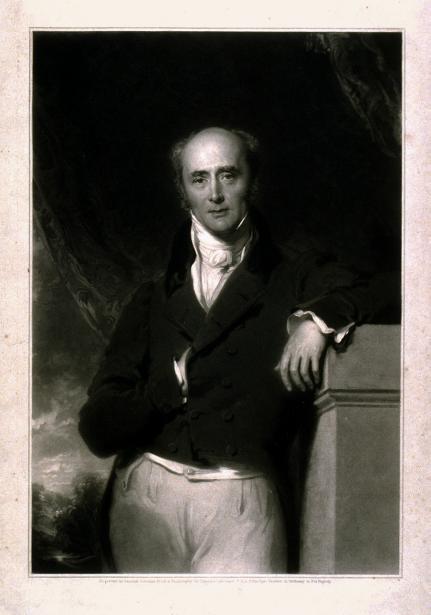
First of all, Earl Grey tea was indeed named after the second Earl Charles Grey of Britain back in the 1830s. Though proof is scarce, he is traditionally credited with the creation of this blended tea. Charles Grey was prime minister from 1830-1834, during which time the act was passed to abolish slavery in the British Empire. Seems like quite an accomplishment, yet most people know him for his wonderful tea instead.

Contrary to popular belief, Earl Grey is not a kind of tea at all. It's actually plain black tea, infused with the citrus flavour of bergamot (similar to orange blossoms). This gives a bright, tart and refreshing tea that is unlike other black teas.

While the term 'orange pekoe' is all about the quality and grade of a tea, Earl Grey tea is not necessarily a high quality tea. Since the taste of bergamot is quite strong, it is often used to mask the lack of flavour from poor quality black tea. When shopping for Earl Grey, make sure to double-check the grade of the tea before making your choice.

Earl Grey tea is a favorite in Britain and in North America, and you can be sure to find it on the menu at any tea room, or in any supermarket.

maandag 19 oktober 2009

Savory Tea Scones

https://blogger.googleusercontent.com/img/b/R29vZ2xl/AVvXsEj1j6Ros5QsOjpxFaleAcas_DMWtBF9gn4DvyqFk0eiAilAHGfq2kCVrPDPxwiIHSEz8EPB92O0vFU5Ck41uIKIzyhkWhi9MoCqoKAObSQ4SbiNirmtyGxWlStzHCH2NbSffU5xDMNjxWpu/s400/Scones2.jpg

Submitted by: Ann Weekley

This is a healthy recipe as olive oil substitutes for the usual butter, oatmeal gives a rustic texture and Pu Erh adds a subtle but earthy flavor.

Ingredients:
Dry ingredients:
One cup quick oats
Two tablespoons of honey
1/2 teaspoon of baking soda
1/2 teaspoon of salt
1 heaping tablespoon of Pu Erh tea

To this add:
2 eggs
10 tablespoons of olive oil
2/3 cup buttermilk.
Directions:
In a 400 degree oven toast oats for 8-10 minutes. Mix dry ingredients thoroughly. To the dry ingredients add the eggs, oil and buttermilk. Stir just till ingredients are moistened. Let stand for five minutes.
Pat the dough into two six inch rounds, cut each round into six wedges. Brush the top with a little olive oil. Bake for 16-18 minutes in the 400 degree oven.

donderdag 8 oktober 2009

Oatmeal tea Muffins

http://www.healthyvegankitchen.com/wp-content/uploads/2008/04/oatmeal-pumpkin-muffins-3.JPG

Ingredients:

3/4 cup milk
3 honey-orange teabags
1 3/4 cups plus 2 tablespoons flour
2 1/4 teaspoons baking powder
3/4 teaspoon baking soda
1/2 teaspoons salt
1 cup old-fashioned oats
3/4 cups light brown sugar
1/2 cup vegetable oil
3 eggs
1 cup raisins


Directions:

In a small saucepan, heat milk just to the simmer. Off heat, add the teabags, submerging them completely. Set mixture aside to cool. When cool, remove teabags, squeezing them to remove liquid.
Adjust rack to lower third of oven and preheat oven to 400 degrees. Grease and flour 12 muffin cups.

In a large bowl, sift flour, baking powder, baking soda, and salt. Stir in the oats and brown sugar. In a small bowl, combine the steeped tea milk, oil, and eggs. With a rubber spatula, make a well in the center of the dry ingredients and pour in the liquid mixture. Stir the ingredients together just to moisten and combine. Do not overmix or the muffins will be tough and coarse in texture. Spoon thick batter into the prepared muffin cups, filling each one 3/4 full. Bake 20 minutes or until muffin springs back when lightly pressed in center. Cool on wire rack for about 5 minutes before carefully removing from pan. Serve warm, if desired.

zaterdag 3 oktober 2009

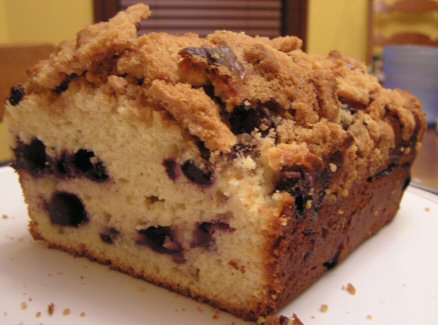
Blueberry Tea Cake

http://kfb1.files.wordpress.com/2007/08/blueberry-tea-cake.jpg

Ingredients:

1 cup milk
3 orange-spice teabags
2 cups sifted flour
2 1/2 teaspoons baking powder
1/2 teaspoon salt
1/3 cup vegetable shortening
1 1/4 cup sugar
1 large egg
1 teaspoon vanilla
1 cup fresh blueberries, room temperature


Directions:

In a small saucepan, heat milk just to the simmer. Off heat, add the teabags, submerging them completely. Set mixture aside to cool. When cool, remove teabags, squeezing them to remove liquid.

Adjust rack to lower third of oven and preheat oven to 350 degrees. Grease and flour a 9-inch square cake pan.

Sift the flour, baking powder, and salt. Using an electric mixer at medium speed, cream the shortening and the sugar to blend thoroughly. Add the egg and vanilla and beat until light and fluffy, about 4 minutes. Add the flour mixture alternately with the steeped tea-flavored milk mixture in three or four additions.

Fold in blueberries and spoon batter into pan. Bake for 25 to 30 minutes or until cake springs back when lightly pressed in center. Cool on wire rack 10 minutes before inverting.

donderdag 1 oktober 2009

Pumpkin/Chocolate Chip Tea Cookies

http://www.rezimo.com/wp-content/uploads//1118/Pumpkin%20Chocolate%20Chip%20Cookies%20Rezimo%20Resize.jpg

Since it's pumpkin season I'd like to share this yummy recipe for Tea Cookies

Submitted by:
Ann Allison


Adding Irish Breakfast Tea does not alter the taste much but certainly helps to make a much more moist cookie which is an excellent choice to accompany a nice hot cup of Irish Breakfast Tea.
Ingredients:
1 cup cooked pumpkin
1 cup sugar
1/2 cup oil
1 egg
2 1/2 cups all purpose flour
2 teaspoons baking powder
1/2 teaspoon salt
1 teaspoon vanilla
1 teaspoon cinnamon
1 teaspoon baking soda dissolved in 1/4 cup
steeped, warm Irish Breakfast Tea
1 cup chocolate chips
1/2 cup chopped walnuts
Directions:
Mix all except the last two ingredients which are added last. Drop by teaspoonsful on parchement lined cookie sheets. Bake in pre-heated 375 degree oven for 10-12 minutes or until lightly browned. Makes about 4 dozen soft cookies.
They freeze very well.
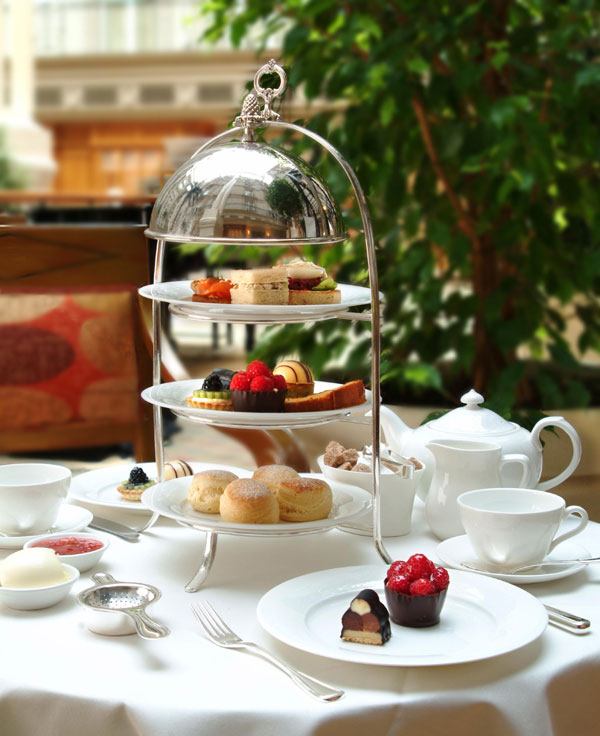
http://morningnoonandnight.files.wordpress.com/2007/10/afternoontea01.jpg
The traditional British Afternoon Tea can still be enjoyed in the elegant and grand surroundings of the country's finest hotels and restaurants. This site will help you to find the perfect Afternoon Tea location and provide all the information you need to make your visit as comfortable as possible - what time is tea served, what should I wear, how much will it cost?

http://www.afternoontea.co.uk/